If you have asked two agencies whether you need a custom WordPress theme or a template, you have probably had two confident answers that contradict each other. The one that builds custom sites told you templates are bloated and slow. The one that works from templates told you custom is a waste of money. Both were describing their own business model.
We build both, so there is no sales answer waiting at the end of this. What follows is what actually changes between the two, what each really costs in 2026, and a way to decide in about five minutes.
First, the three words everyone mixes up
Most of the confusion in this decision is vocabulary, not strategy. Three different things get called the same thing.
A theme controls how your whole site looks and behaves. Change the theme and you change every page at once.
A template is a layout for one type of page inside that theme. Your blog post layout and your contact page layout are templates. A theme ships with several of them.
A page builder, such as Elementor or Bricks, is a tool that lets you lay out pages visually without writing code. It sits on top of a theme rather than replacing it.
So “custom theme vs template” is really a question about how much of your site is built to fit your business, and how much is bought ready-made and adjusted. Keep that in mind, because the useful answer is not either of the two things people usually argue about.
What you actually get with an off-the-shelf theme
You buy a theme from somewhere like ThemeForest, or use a free one, and you get a complete design on day one. You can see what the site will look like before you spend anything meaningful, which is genuinely reassuring when you have never commissioned a website before.
You are usually live in days rather than months. If your needs are ordinary, which for a lot of businesses they honestly are, you get most of what you need for a few hundred pounds.
The costs are real but they show up later. A theme sold to thousands of businesses has to support all of them, so it ships with sliders, portfolio layouts, booking widgets and shop features you will never use. That code still loads. You inherit the author’s decisions about heading structure and markup, and if they made poor ones you are working around them for the life of the site.
You also inherit their maintenance. If the author stops updating the theme, which happens more often than anyone admits, you are on a slow path to a rebuild. And a security flaw in a popular theme is a flaw in every site using it, which makes popular themes worth attacking.
What you actually get with a custom theme
A custom WordPress theme is built for your business. Nothing is in there that you did not ask for, which is where the performance argument comes from: there is no unused code to load because nobody wrote any.
You get to decide the structure. If your business has an unusual booking flow, a product configurator, or a way of presenting work that no template anticipated, a custom build just does it rather than bending something else into shape.
It is also yours. Nobody can stop supporting it and leave you stranded, and nobody else is running the same code, which makes you a much less interesting target.
The honest downsides: it costs several times more, it takes weeks rather than days, and you cannot see it before it exists. You are buying from a drawing. That puts real weight on choosing someone whose previous work you can actually look at.
There is a quieter risk too. A custom theme built by someone who disappears is worse than a template, because now nobody understands the code. Ask who maintains it afterwards before you sign anything.
The third option almost nobody mentions
The custom-or-template argument is mostly a leftover from about 2015. Most good WordPress sites built today are neither.
The common approach now is a deliberately minimal theme, something like Hello, GeneratePress or Kadence, which does almost nothing on its own, combined with a page builder for layout. The theme stays out of the way, you design the pages to fit the business, and you are not carrying a thousand features you never asked for.
This is what we build for most clients, and it is worth being clear about why. It gets you most of the control of a custom build at a fraction of the cost, and it leaves the site editable by a normal person afterwards instead of requiring a developer for every text change.
It is not free of trade-offs. Page builders add markup of their own, and a badly built page builder site can end up heavier than the template it replaced. The tool does not save you from poor execution. But a carefully built one is fast, and it is the realistic middle for most businesses between a few hundred pounds and a five-figure custom project.
What each one really costs
Published figures vary wildly because most of them come from people selling the thing they are pricing. These are the ranges that come up consistently across agency and freelancer quotes in 2026, in pounds, for a small to medium business site. Treat them as a sense of scale rather than a quote.
| Approach | Typical build cost | Time to launch | Who can edit it after |
|---|---|---|---|
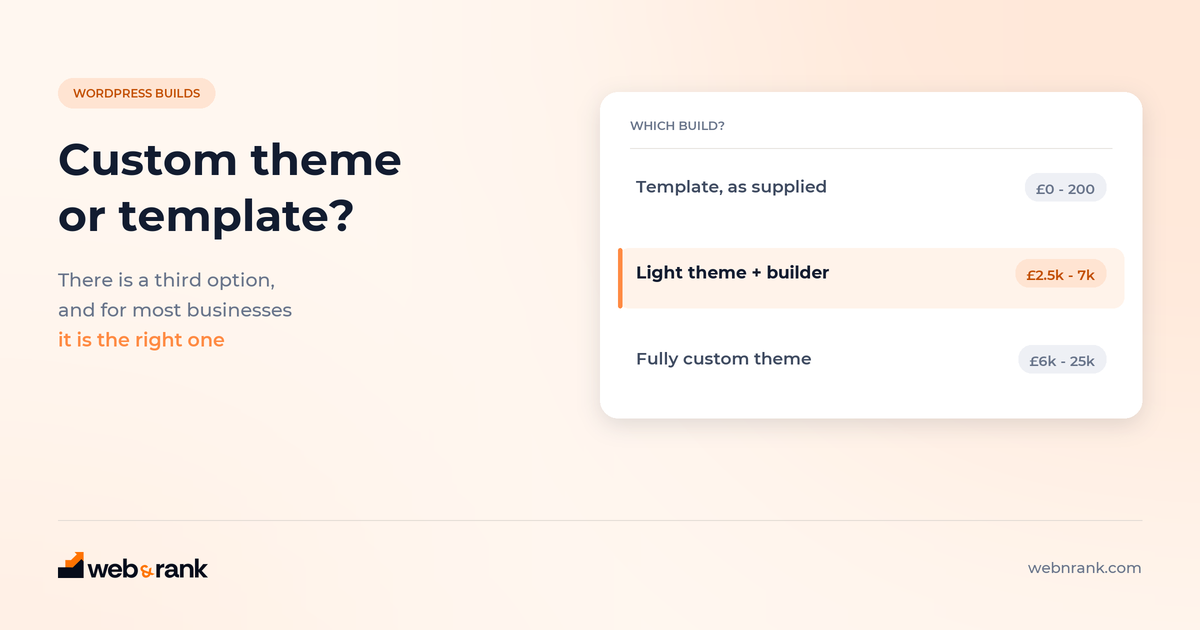
| Free or premium theme, used as supplied | £0 to £200 for the theme | Days | You, within the theme’s limits |
| Premium theme, customised by an agency | £1,200 to £4,000 | 2 to 4 weeks | You, for content |
| Light theme plus page builder | £2,500 to £7,000 | 3 to 6 weeks | You, including layout |
| Fully custom theme | £6,000 to £25,000+ | 6 to 16 weeks | Usually a developer |
The figure that catches people out is not the build. It is that the cheapest option tends to have the shortest life. A £500 template site that needs replacing in two years costs more than a £4,000 site that lasts six, and the replacement costs you your rankings and your time as well as the invoice.
Does a custom theme actually rank better?
This is where most articles on this topic overclaim, so here is the straight answer: there is no credible evidence that Google ranks custom themes above templates. We went looking for controlled data while writing this and could not find any. Google does not know or care how your theme was made.
What it does measure is the result. Those are different claims and it matters which one you believe.
Where the build genuinely affects SEO:
- Page speed. Core Web Vitals are a real ranking signal, and a heavy theme loading unused code is a real way to fail them. That is a speed problem you can fix on either kind of build.
- Heading structure and markup. Some themes produce genuinely bad HTML, several H1s on a page, or headings chosen for how big the text looks. You can fix this in a template, but you are fixing it rather than never having had it.
- Schema. Plenty of themes ship none, and plenty ship it broken. Most sites handle this with an SEO plugin anyway, and the rest is ordinary on-page work.
- What you can actually build. If the template cannot produce the page your best keyword needs, that is an SEO ceiling, just not the kind people usually mean.
A well-chosen lightweight theme on good hosting, with real content behind it, will out-rank a custom build with thin content every time. If someone tells you a custom theme will fix your rankings, ask them which of the four things above they are actually proposing to change.
The cost that turns up two years later
Day-one price is the number everyone compares. It is rarely the number that decides which was cheaper.
Theme sites accumulate plugins. Something the theme cannot do gets solved by installing something, and three years later the site runs twenty-six plugins, four of which overlap, and an update to any one of them can take the site down. Each one is also a way in, which is why someone has to own the updates.
Then the theme author ships a major version that breaks your customisations, or stops shipping anything at all. Either way you are rebuilding.
Custom sites have their own version of this. The risk is not bloat, it is knowledge. If the build is undocumented and the developer moves on, you own code nobody can safely touch. That is a slower failure but a more expensive one.
The question worth asking is not “what does this cost” but “what does this cost to still have in three years”.
How to decide in about five minutes
Work through these honestly and the answer usually picks itself.
Choose a template, used mostly as supplied, if the website is a brochure rather than a sales channel, you need to be live in weeks, your budget is under about a thousand pounds, and nothing about how you work is unusual. There is no shame in this. A good template with strong content beats an expensive site with nothing to say.
Choose a light theme with a page builder if the site is expected to bring in enquiries, you want to look like yourself rather than like a theme demo, you want to edit pages without calling anyone, and you can spend a few thousand. This is the right answer for most businesses reading this.
Choose a fully custom theme if the site does something genuinely specific, a configurator, a members area, a booking flow nothing off the shelf handles, or you are at a scale where a few per cent of conversion is worth more than the build cost, and you have the budget and someone to maintain it.
One more test that cuts through all of it. Ask what happens if the business doubles. If the honest answer is that you would rebuild, build the thing that does not need rebuilding.
Common questions
Is a custom WordPress theme worth it?
It is worth it when the website is a revenue asset rather than a brochure, when something about how you operate does not fit an off-the-shelf layout, and when you have the budget to maintain it afterwards. For a straightforward business site, a lightweight theme with a page builder gets you most of the benefit for a fraction of the cost.
What is the difference between a WordPress theme and a template?
A theme controls the look and behaviour of the entire site. A template is the layout for one type of page inside that theme, such as a blog post or a contact page. A theme contains several templates.
Are custom WordPress themes faster than templates?
They usually are, because they contain only the code the site needs, while a commercial theme carries features for every buyer. But a well-chosen lightweight theme can be just as fast, and a badly built custom theme can be slower. The speed comes from what is loaded, not from who built it.
Do custom themes rank better in Google?
Not directly. Google has no way of telling how your theme was built. Custom work can help indirectly through faster loading, cleaner heading structure and the freedom to build the pages your keywords need, but content and technical health matter far more than the theme.
How much does a custom WordPress theme cost in the UK?
Typical agency quotes for a small to medium business run from about £6,000 to £25,000, depending on how much bespoke functionality is involved. A premium theme customised by an agency usually lands between £1,200 and £4,000, and a light theme with a page builder between £2,500 and £7,000.
Can I switch from a template to a custom theme later?
Yes, and it is a normal step as a business grows. Your content, URLs and rankings can be carried across if the move is planned properly. The work is in mapping the URLs and preserving the on-page structure, not in moving the content itself.
Is Elementor bad for SEO?
No, but it is not automatically good either. Page builders add markup, so a carelessly built Elementor site can be heavy. A carefully built one on a minimal theme performs well. The deciding factor is how it was built, not that a builder was used.
Not sure which one your business actually needs?
Tell us what the site has to do and we will tell you honestly which of the three is the right fit, including when the answer is a template. We build WordPress sites for businesses in the UK, US, Canada, Australia and New Zealand.