AI implementation services for work that genuinely needs a judgement
Most of what gets sold as AI is a rule with better marketing. If the logic is fixed, a rule is cheaper, faster and you can debug it. AI earns its place where something has to be read, sorted or judged, and the variety is too wide to write rules for. We build that, and we tell you when you do not need it. AI implementation services for teams across the US, UK, Canada, Australia and New Zealand.
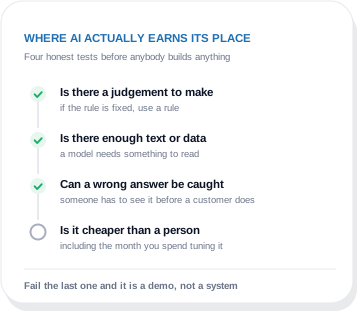
Four questions before anybody builds anything
We run these on the first call. Failing one is usually fatal, and it is much cheaper to fail it in a conversation than in month three.
Is there a judgement to make
If the answer follows a fixed rule, write the rule. Rules are cheaper, instant, free to run and you can explain them to an auditor. Most of what people ask us to build with AI is a rule wearing a costume.
Is there enough text or data
A model needs something to read. Free-text enquiries, documents, transcripts, product descriptions, support tickets. If the input is three tick boxes, there is nothing for it to work with.
Can a wrong answer be caught
This is the one people skip. Every model is wrong sometimes, so the question is whether a human sees it before a customer does. Where a wrong answer reaches the customer unreviewed, the design has to change or the project should not happen.
Is it cheaper than a person
Including the month spent tuning it and the tokens it burns every day. Plenty of tasks are genuinely cheaper done by somebody for two hours a week, and we would rather say so than build you a demo.
Six things that actually work
AI implementation services in practice, in rough order of how often the result justifies the build.
Reading documents into structured data
Invoices, purchase orders, forms, contracts, statements. Genuinely the strongest use we see: the input is messy, the output is structured, and a person can verify a batch in minutes instead of typing it.
Sorting and routing what arrives
Enquiries, tickets, applications and messages classified and sent to the right person or queue. The judgement is real, the volume is high and a mistake is cheap to correct.
Answering the same question for the thousandth time
Support and pre-sales chat grounded in your own documentation, with a clear path to a human. It works when the scope is narrow and the answers exist somewhere in writing.
Search that understands the question
Semantic search across your own content, so people find the right policy or product without guessing the exact words. Unglamorous and consistently useful.
First drafts, never final ones
Product descriptions, summaries, replies. The value is removing the blank page, and a person still edits. Publishing unread output is how brands end up apologising.
Forecasting where you have real history
Demand, churn or volume, where you have years of clean data. Without the history this is astrology with a confidence interval, and we will say so.
Where this stops and automation starts
These get conflated constantly, usually by people selling one of them. The line is simple.
Automation connects things that already exist
A form fills a CRM, a won deal raises an invoice, a missed call sends a text. No judgement, no model, and it should not cost model money to run. That is our business automation work and it is where most businesses should start.
AI adds a judgement to the chain
Reading the enquiry and deciding which queue, extracting the total from an invoice that has a different layout every time. The model does the part a rule cannot.
Most useful systems are mostly automation
A typical build is ninety percent plumbing and one model call in the middle. Agencies that lead with the model usually end up charging for the plumbing anyway.
What we can show you, and what we cannot
This is a newer service line and the page should say so rather than imply a decade of it.
An online store. Automation rather than AI, included because it is the shape most of this work takes underneath.
A cleaning service, where the automated path replaced a phone tag loop. Again automation, not a model.
What the model is asked, what it costs to run per month, who reviews the output and what happens when it is wrong.
No published AI case study yet
We build this work, and we have not published a result with a number on it. Rather than dress up an automation project as an AI one, here is the honest position: the plumbing under these systems is exactly what the case studies above show, and the model layer is the newer part. If you need a vendor with a published AI track record, that is a fair requirement and we are not it yet. Ask on the call and we will tell you what we have actually shipped.
Rated 4.9 out of 5 across more than 2,800 client reviews
We work with clients directly and on monthly retainers. We also work through Fiverr and Upwork, where we hold Top Rated and Top Rated Plus status. Here is what a few recent website and SEO clients said.


- Verified on Upwork
- Verified on Upwork
- Verified on Fiverr
- Verified on Upwork
- Direct client
- Verified on Upwork
- Verified on Fiverr
- Verified on Upwork
Four things we will not build
This field attracts more nonsense than any other we work in. Here is where we stop.
Replace your support team with a bot
The ones that work are narrow, grounded in your own documentation and hand over to a human quickly. The ones that go viral for the wrong reasons were asked to improvise.
Put your customer data somewhere you cannot name
You should know which provider processes what, where it is held and whether it trains on your inputs. We will put that in writing, and if the answer is unacceptable we will design around it.
Build a demo that cannot run in production
Anything that works only when a person babysits it is a prototype. Error handling, cost limits and a review path are part of the build, not a later phase.
Chase whatever launched last week
Model choice is a cost and reliability decision, not a fashion one. We will pick the cheapest model that passes your accuracy bar and change it when there is a reason.
Questions about AI work
This sits alongside our automation and software development work.
Have a task in mind?
Describe it in a sentence and we will run the four tests on the call. Roughly half the time the answer is that a rule or an automation does it cheaper.
What do AI implementation services cost?
A focused build such as document extraction or enquiry routing is usually 4,000 to 12,000 US dollars, plus what the model costs to run, which is often ten to a few hundred dollars a month depending on volume. We quote both separately, because the running cost is the part people are surprised by later.
Will it be wrong sometimes?
Yes. Every model is, and any vendor implying otherwise is one you should walk away from. What matters is the design around it: how wrong answers get caught, who reviews what, and whether a mistake is cheap or expensive. We build the review path before the model.
Do we need our own model?
Almost certainly not. Training a custom model needs data most businesses do not have and rarely beats a good general model with your own documents supplied as context. We will tell you honestly if yours is one of the rare cases where it is worth it.
Where does our data go?
To whichever provider we agree on, and you will know which one, what it receives and whether it is used for training. For sensitive work there are providers and settings that keep data out of training entirely, and self-hosted options where that is genuinely required. This gets decided before anything is built.
Is this different from your automation work?
Yes, and the difference matters when you are deciding what to buy. Automation connects tools that already exist and makes no judgements. AI adds a judgement. Most businesses get more from automation first, and we will say so rather than sell the more interesting thing.
Can you add AI to our existing system?
Usually, and that is most of what we do. It is rarely a new product; it is a model call inserted into a process that already runs, plus the handling around it. That is cheaper than it sounds and much easier to reverse if it does not pay.
How do we know if it worked?
We agree the measure before building: hours saved, error rate, time to first response, or cost per item processed. Then we record the baseline. If a build cannot be tied to one of those, that is usually a sign it should not be built.
Tell us what you need and we will show you how we would do it
Share a few details about your business and what you want to fix or build. It could be a new website, a WordPress site that keeps breaking, SEO that has stalled, or a sales process that needs automating. We will come back with honest advice, even if that means a smaller job than you expected.
A reply within one business day
A real person on the team reads your message and replies, usually the same day.
A free review of your current setup
We look at your website, rankings or systems before we talk, so the call is useful.
A written proposal
You get a clear scope, timeline and price in writing before any work starts.
Prefer to talk first?