Custom mobile app development, starting with whether you need one
Roughly half the people who ask us for an app need a faster mobile site instead, and we will say so before you spend anything. When an app genuinely is the answer, we build it cross platform so one codebase serves iOS and Android. Clients across the US, UK, Canada, Australia and New Zealand.

Do you actually need an app?
An app costs more to build and far more to keep alive than a mobile site, because it has to be maintained against two operating systems that change every year. It is worth it for specific reasons, and not worth it for the most common one, which is that a competitor has one.
An app earns its place when
- People use it repeatedly, not once a year
- You need push notifications that actually get seen
- It has to work with no signal
- You need the camera, GPS, Bluetooth or biometrics
- Users are staff and the phone is a work tool
- Being on the home screen changes the habit
A mobile site or PWA is enough when
- People use it occasionally or once
- You mainly need people to read, book or buy
- Discovery matters and you want search traffic
- Asking for an install would lose most of them
- Budget is better spent on the site you already have
- You have not tested the idea with anyone yet
A progressive web app sits between the two. It installs to the home screen, works offline and sends notifications on both platforms now, without app store review. For a lot of businesses that is the honest answer, and it is a shorter, cheaper project.
Native, cross platform, or a PWA
Same brief, three very different budgets. We pick with you rather than defaulting to the one that bills most.
Native
Swift for iOS, Kotlin for Android. Two codebases, two sets of work, the best possible performance and the earliest access to new OS features.
- Best for heavy graphics or hardware
- Two builds to maintain forever
- The most expensive route by some margin
Cross platform
Cross platform app development in React Native, one codebase for both stores, with native modules where something genuinely needs them. It is what we build most often as a React Native development company, and what most business apps should be.
- One team, one codebase, both platforms
- Shares logic with your web app
- Near native for anything that is not a game
- Usually the right call
Progressive web app
Installs from the browser, no app store review, updates the moment you deploy. Camera and offline work, and push notifications on both platforms.
- Cheapest and fastest to ship
- No store fees or review delays
- Not in the App Store, which some clients want
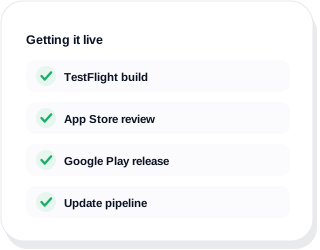
Shipping an app is a project of its own
People budget for the build and forget everything after it, which is where app projects quietly die.
- Developer accounts, certificates and provisioning in your name
- TestFlight and Play internal testing so real people try it first
- App Store and Google Play review, which can reject you for reasons nobody warned about
- Store listings, screenshots and privacy labels
- Crash reporting and analytics from day one, not after the first bad review
- An update pipeline, because both platforms force changes on you every year
- Backend and API maintenance, since the app is only the visible half
What you get before anyone writes code
We would rather lose an app project at the first call than build something that gets installed forty times.
A straight answer on the route
Native, cross platform or a PWA, with the reasoning and the cost difference written down so you can push back on it.
A clickable prototype first
Screens you can tap through on your own phone before the build starts. Far cheaper to change a prototype than a codebase.
Accounts in your name
Apple and Google developer accounts, signing certificates and the repository all belong to you. If you leave, the app goes with you.
Rated 4.9 out of 5 across more than 2,800 client reviews
We work with clients directly and on monthly retainers. We also work through Fiverr and Upwork, where we hold Top Rated and Top Rated Plus status. Here is what a few recent website and SEO clients said.


- Verified on Upwork
- Verified on Upwork
- Verified on Fiverr
- Verified on Upwork
- Direct client
- Verified on Upwork
- Verified on Fiverr
- Verified on Upwork
App questions, answered straight
Not sure an app is the right shape at all? Start at software development services.
Tell us what the app would do
Who opens it, how often, and what happens when they do. We will tell you whether it needs to be an app at all, and we will not be offended if the answer costs us the job.
How much does it cost to have a mobile app developed?
A focused cross platform app with accounts, a handful of screens and an API behind it is a several month project. Native for both platforms is roughly double, because it is two builds. A progressive web app is a fraction of either. Custom mobile app development is priced from a written spec after a scoping phase, not from a description over the phone.
Should I build native or cross platform?
Cross platform with React Native for most business apps, because one codebase serves both stores and shares logic with your web app. Go native when you need heavy graphics, deep hardware access or the newest OS features on day one. Anybody who answers this without asking what the app does is guessing.
How long does a mobile app take?
Three to four months is realistic for a first version with accounts, a few core screens and a backend. Add time for store review, which is unpredictable and has rejected apps for things nobody anticipated. Prototyping first shortens the build because the arguments happen on paper.
Do we need both iOS and Android?
Not always, and launching on one is a legitimate way to test the idea for half the money. Check your own analytics for the split before deciding. Cross platform makes adding the second one cheap, which is another argument for it.
What about getting into the App Store?
We handle submission, but the accounts stay in your name. Expect review to take days rather than hours and to occasionally come back with something unexpected. Apple is stricter than Google, particularly on payments, account deletion and anything that looks like a repackaged website.
Who maintains it after launch?
Somebody has to. iOS and Android both ship breaking changes yearly, certificates expire, and dependencies need patching. That runs as a retainer or ad hoc, and an unmaintained app stops working within about eighteen months.
Tell us what you need and we will show you how we would do it
Share a few details about your business and what you want to fix or build. It could be a new website, a WordPress site that keeps breaking, SEO that has stalled, or a sales process that needs automating. We will come back with honest advice, even if that means a smaller job than you expected.
A reply within one business day
A real person on the team reads your message and replies, usually the same day.
A free review of your current setup
We look at your website, rankings or systems before we talk, so the call is useful.
A written proposal
You get a clear scope, timeline and price in writing before any work starts.
Prefer to talk first?