Software development services for businesses running on spreadsheets
Most custom software starts as a spreadsheet somebody maintains by hand, or three systems that do not talk to each other. We build the thing that replaces it. Software development services for businesses across the US, UK, Canada, Australia and New Zealand, scoped properly before anybody writes code.
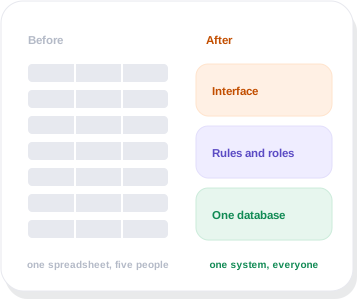
What custom software actually gets built for
After enough of these projects, nearly all of them are one of four problems. If yours is not on this list, say so and we will tell you honestly whether it is our kind of job.
The spreadsheet that runs the business
Somebody exports, edits and re-imports, and the whole company waits for them. It works until they are on holiday or the file hits a row limit.
- One database instead of six files
- Roles so people see their own work
- An audit trail of who changed what
Systems that do not talk
The CRM, the booking tool and the accounts package each hold a piece of the truth, and a person is the integration between them. Legacy systems with no API are the usual culprit.
- API and webhook integrations
- Scheduled syncs that run themselves
- One place to see the whole picture
Customers who need a login
A portal where clients check progress, download documents or submit work. Bolting a membership plugin onto a brochure site rarely survives contact with real users.
- Authentication and user roles
- Self service instead of email
- Permissions that match your structure
Work somebody does by hand every week
Reports assembled from four places, invoices retyped, data copied between tools. Nobody planned it, it accumulated.
- Automation with a human check
- Scheduled reporting
- Dashboards instead of exports
What we build, and where to read more
Most software we build is one of these two. Each has its own page with the detail.
Dashboards, client portals, internal tools and SaaS products. Anything where people sign in and do work rather than read.
- SaaS and portals
- User roles and permissions
- REST APIs and integrations
- React, Node and PostgreSQL
iOS and Android, usually cross platform from one codebase. We start by telling you honestly whether you need an app at all.
- React Native
- Cross platform or native
- App Store and Google Play
- PWA when that is the better answer
Discovery, and why we insist on it
Custom software goes wrong when somebody quotes a number for a thing nobody has described yet. So the first stage is a paid piece of work with its own deliverable, and it is useful even if you never build anything.
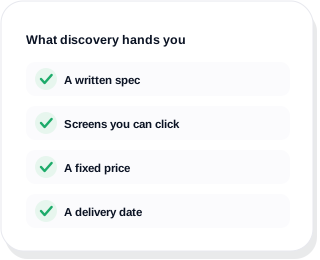
We sit with the people who do the work, map what actually happens rather than what the process document claims, and write it down. You get requirements in plain English, screens you can click through, an architecture that names the database and the integrations, and a fixed price with a date.
If you take that document to another developer, it will still be worth what you paid for it. That is deliberate.
Fixed price or a monthly team
The wrong commercial shape is how custom projects sour, so we pick it on purpose rather than by habit.
Fixed price, from the spec
For work discovery has described properly. You know the number and the date, and we carry the risk of having estimated it wrong.
- Scope agreed in writing first
- 50% up front, 50% on delivery
- Changes quoted separately and openly
- Best when the shape is known
A monthly team
For work that will keep evolving, including an MVP you intend to learn from. Agile in the plain sense: priorities set every two weeks, something working at the end of each one.
- You set the priorities each sprint
- Working software every fortnight
- Stop when it is good enough
- Best when the shape will emerge
What we will not do is quote a fixed price for something nobody has specified. That is how both sides end up angry six months in.
Things we built that did not exist before
Including one we built for ourselves, then gave away.
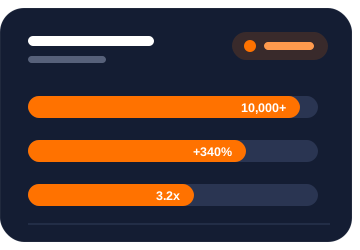
Monthly users on DNS Previewer, built because we kept needing it on migrations. React front end, lightweight API, six weeks.
Signup rate against the old page. SaaS company landing page, rebuilt around one job instead of five.
Booking enquiries within 30 days. Residential cleaning service, with an instant quote calculator that did not exist off the shelf.
Rated 4.9 out of 5 across more than 2,800 client reviews
We work with clients directly and on monthly retainers. We also work through Fiverr and Upwork, where we hold Top Rated and Top Rated Plus status. Here is what a few recent website and SEO clients said.


- Verified on Upwork
- Verified on Upwork
- Verified on Fiverr
- Verified on Upwork
- Direct client
- Verified on Upwork
- Verified on Fiverr
- Verified on Upwork
Software questions, answered straight
Two things live under this: web applications and mobile apps.
Got a spreadsheet doing a system’s job?
Describe what it does and who touches it. We will tell you whether it is worth building properly, and roughly what that looks like, before any money changes hands.
What is a software development service?
In practice it means a custom software development company builds to your requirements rather than selling you a product. That covers the whole lifecycle: working out what is needed, designing it, building it, testing it, putting it live and keeping it running. The part people underestimate is the first and the last.
How much do software development services typically cost?
A small internal tool that replaces a spreadsheet is a few weeks of work. Something with user accounts, permissions and integrations into systems you already run is a few months. Rather than guess, we quote a fixed price from the discovery document, so the number is attached to a description you have read and agreed.
What are the 7 stages of SDLC?
Planning, requirements, design, build, testing, deployment and maintenance. Useful as a checklist, less useful as a schedule, because in real projects testing and requirements keep happening throughout rather than finishing neatly. We run discovery, then build in two week increments with testing inside each one, then support.
What are the 12 types of software developers?
It is a list that varies depending who is writing it, and the honest answer is that titles matter less than whether the person has built the thing you need before. For a business system you want someone comfortable across frontend, backend, database and the integrations, rather than four specialists coordinating.
Do we own the code?
Yes, in your own repository from the first commit, along with the right to take it to another developer tomorrow. Handover documentation is written on the assumption that one day you will.
What about security and data protection?
Authentication and role based permissions from the start rather than bolted on, encryption in transit and at rest, no production data in test environments, and GDPR considerations built into how data is stored and deleted. If you are handling anything sensitive, say so early because it changes the architecture.
What happens after it is live?
Software is not finished, it is released. Cloud hosting on AWS or a managed platform in your own account, monitoring, security patching and the small changes people ask for once they actually use it. That runs either as a support retainer or ad hoc, and it is cheaper to plan for than to discover.
Tell us what you need and we will show you how we would do it
Share a few details about your business and what you want to fix or build. It could be a new website, a WordPress site that keeps breaking, SEO that has stalled, or a sales process that needs automating. We will come back with honest advice, even if that means a smaller job than you expected.
A reply within one business day
A real person on the team reads your message and replies, usually the same day.
A free review of your current setup
We look at your website, rankings or systems before we talk, so the call is useful.
A written proposal
You get a clear scope, timeline and price in writing before any work starts.
Prefer to talk first?