Salesforce integration services for teams whose CRM sits on an island
Salesforce holds clean data and your finance system holds different data, and somebody spends Thursday afternoon making them agree. We connect it to the systems around it and automate the steps people are doing by hand inside it. Salesforce integration services for teams across the US, UK, Canada, Australia and New Zealand.
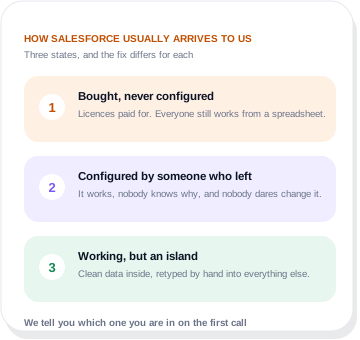
The three states Salesforce arrives in
Almost every org we are called into is one of these. The work is different for each, which is why the first call is about working out which one you are in rather than quoting a package.
Bought, never configured
Licences have been paid for since last year and the team still works from a spreadsheet. Nobody was given the time to set it up, so nobody trusts what is in it.
- Objects and fields that match your business
- Record types and page layouts people will actually use
- A migration that brings the spreadsheet in, deduplicated
Configured by someone who left
It works. Nobody knows why. There are eleven validation rules, four of them fighting each other, and everyone has learned which fields to leave blank to avoid an error.
- An audit of what exists and what fires
- Rules documented, then simplified
- Changes made in a sandbox, never on live records
Working, but an island
The data inside is clean and it is retyped by hand into the accounting system, the support desk and a reporting spreadsheet. Salesforce is right and everything else is a day behind.
- Two way sync with the systems that matter
- Webhooks in, API calls out, with a readable log
- One set of numbers instead of three
What we build
Salesforce automation services in practice, listed roughly in the order clients ask for them.
Flow Builder instead of a pile of connectors
Record triggered flows, scheduled flows and screen flows built inside Salesforce where they are visible and maintainable, rather than a stack of one off connectors nobody can audit.
Integrations with what you already run
Accounting, support desk, marketing tools, ERP systems, your website and any third party service with an API worth talking to. Native connector where one exists, middleware or a direct API build where it does not.
Data migration and deduplication
Getting the spreadsheet, the old CRM or the second org in without importing ten years of duplicate records. Matching rules and duplicate rules set before anything loads.
Validation and approval processes
Fields that must not be blank, discounts that need a manager, quotes that cannot go out at the wrong price. Written down as rules your team agreed to, not invented by us.
Reports and dashboards people use
Built from how the business is actually measured, so the Monday meeting reads a dashboard rather than a spreadsheet somebody assembled on Sunday night.
Profiles, permissions and handover
Who can see what, who can change what, and a written record of it. Plus a walkthrough recording so your admin can maintain what we built.
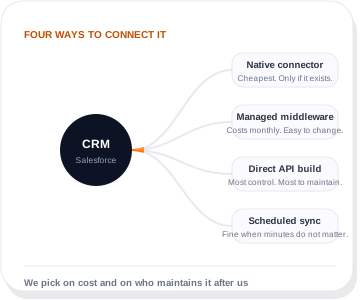
Four ways in, and the trade off for each
There is no universally right answer here. We pick on what it costs to run and on who has to maintain it once we are gone.
- A native connector is cheapest and simplest, and only an option when one genuinely exists for your system
- Managed middleware costs a monthly fee but is the easiest to change later without a developer
- A direct API build gives the most control and is the most to maintain, so it needs a reason
- A scheduled sync is perfectly fine whenever the data does not have to be right to the minute
Real time is not always the goal
Real time costs more to build and more to keep alive. Plenty of finance integrations are better off running nightly, and we will tell you when that is the case rather than selling the harder option.
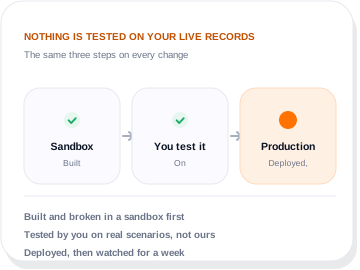
Nothing gets tested on your live records
A CRM holds the only copy of your customer history. That changes how carefully you move, and it is the part of a Salesforce implementation that cheap work skips.
- Everything is built and broken in a sandbox first, including the data migration, which gets a dry run
- You test it on real scenarios of your own choosing before anything is deployed
- Changes go to production in a deployment, then get watched for a week
- Nothing is deleted during a migration. The old data stays readable until you say otherwise
If a change turns out to be wrong, it should cost an afternoon rather than a quarter of your pipeline.
What we can show you
Our published automation results are GoHighLevel and website work rather than Salesforce. Different platform, same discipline, and we would rather point you at real numbers than dress up somebody else’s as ours.
An online store, where cart recovery and post purchase follow up now run on a schedule. GoHighLevel, not Salesforce.
A cleaning service, where online booking and an instant quote calculator replaced a game of phone tag.
A written audit of what your org does today, everything built in a sandbox and tested by you, and a walkthrough recording at the end.
A Salesforce Certified Administrator on the team
That is Salesforce’s own exam on how the platform actually works: objects and fields, security and access, automation, reports and data management. It is held by a person rather than a company, which is a different thing from the partner programme below, and it is why we can work inside your org without learning on your data.
Want to speak to a client about Salesforce specifically?
Ask on the call. We will tell you honestly what we can and cannot put in front of you, which is a better use of your time than a page full of logos. The case studies show the automation work we have published.
Rated 4.9 out of 5 across more than 2,800 client reviews
We work with clients directly and on monthly retainers. We also work through Fiverr and Upwork, where we hold Top Rated and Top Rated Plus status. Here is what a few recent website and SEO clients said.


- Verified on Upwork
- Verified on Upwork
- Verified on Fiverr
- Verified on Upwork
- Direct client
- Verified on Upwork
- Verified on Fiverr
- Verified on Upwork
Four things we are not
Worth knowing before you spend a call finding out. If one of these rules us out, better now than in week three.
We are not a registered Salesforce partner
There is a distinction worth knowing here. We have a Salesforce Certified Administrator on the team, which is Salesforce’s own credential and sits with a person. What we do not have is a place in their consulting partner programme, which is a company listing. If your procurement requires a registered partner on the contract, say so on the first call and we will tell you straight away that we are not it.
We do not take five hundred seat rollouts
A global rollout across several business units needs a firm with a bench and a programme manager. We work with teams of roughly five to eighty seats, where one person can hold the whole picture.
We do not write Apex for the sake of it
Most of what clients think needs code can be done in Flow Builder, where their own admin can still read it. We write Apex when the platform genuinely cannot do the job, and we tell you why.
We do not hold your org hostage
Work happens in your org, under your licences, with your admin able to see everything we do. No agency-owned middleware account that stops working the day you stop paying us.
What it costs, and who you pay
Two separate bills, and it matters which is which. One goes to Salesforce and one goes to us.
What you pay Salesforce
Licences, bought direct from Salesforce and never through us. They are priced per user per month and the edition drives the number, so a ten seat team on a basic edition and a ten seat team needing the automation features pay very different amounts. Check current pricing with Salesforce before you budget, and ask them about annual terms.
- Billed by Salesforce, per user, per month
- The edition decides which automation you can even use
- We do not resell licences or take a margin on them
What you pay us
A fixed fee agreed after a scoping call. A focused integration between two systems usually lands between 3,000 and 9,000 US dollars, driven more by the state of your data than by how many systems are involved. A full build with migration, automation and training is larger and gets quoted in phases rather than as one lump.
- The scoping call and the written plan cost nothing
- Fixed price, agreed before any build starts
- Optional monthly Salesforce admin services afterwards
Salesforce integration services questions
This sits under our business automation services, alongside GoHighLevel.
Got an org nobody trusts?
Tell us what it is connected to and what your team still does by hand. We will tell you which of the three states you are in and what it takes to get out of it.
What does a Salesforce integration cost?
Most connect-two-systems jobs land between 3,000 and 9,000 US dollars depending on how many objects are involved and how bad the data is. Data quality drives the number more than anything else. A full Salesforce implementation from a standing start is larger, and both get quoted as a fixed price after a scoping call rather than hourly.
Are you Salesforce certified, and are you a Salesforce partner?
Two different questions. Certified, yes: we have a Salesforce Certified Administrator on the team, which is Salesforce’s own exam covering configuration, security, automation and data management. A partner, no: we are not in their consulting partner programme, which is a company listing rather than a personal credential. For most teams under a hundred seats that makes no practical difference, and if your procurement needs a registered partner on the contract then we are the wrong firm, which is worth knowing early.
Can you fix an org somebody else set up?
That is a large share of what we do. We audit what exists, list what fires and what it touches, and tell you what is worth keeping. The usual finding is validation rules nobody can explain and automation left behind by a workflow that was half migrated to Flow.
How do you avoid breaking things during a migration?
A sandbox, a dry run of the import, matching and duplicate rules agreed before any data loads, and nothing deleted on the way. You get a rollback position. Salesforce crm consulting that skips the dry run is the reason most people have a horror story.
Do we need a Salesforce admin afterwards?
Not necessarily, but somebody has to own it. For smaller teams that is often a capable person internally, working from the documentation and the walkthrough we leave. Where nobody can take it on, we offer Salesforce admin services on a monthly retainer, and we would rather do that than watch a good build rot.
Should we be on Salesforce at all?
Sometimes not. If you are a service business running on inbound calls and texts, something lighter is usually a better fit, and our GoHighLevel page covers that. Salesforce earns its cost once you have a real sales team, a real pipeline and reporting somebody is accountable for.
How long does it take?
A focused integration is two to five weeks. A full implementation with migration, automation and training is more like six to twelve, and the honest variable is how quickly your team can agree the rules. The building is rarely the slow part.
Tell us what you need and we will show you how we would do it
Share a few details about your business and what you want to fix or build. It could be a new website, a WordPress site that keeps breaking, SEO that has stalled, or a sales process that needs automating. We will come back with honest advice, even if that means a smaller job than you expected.
A reply within one business day
A real person on the team reads your message and replies, usually the same day.
A free review of your current setup
We look at your website, rankings or systems before we talk, so the call is useful.
A written proposal
You get a clear scope, timeline and price in writing before any work starts.
Prefer to talk first?