Commercial real estate website design for a small and serious audience
A commercial listing is not sold the way a house is. Far fewer people will ever look at it, each one is worth a great deal more, and most of them arrive because somebody sent them the link rather than because they searched. That changes what the site is for: less gallery, more document, and a way of knowing who has the information pack. Working with agencies and landlords across the US, UK, Canada, Australia and New Zealand.
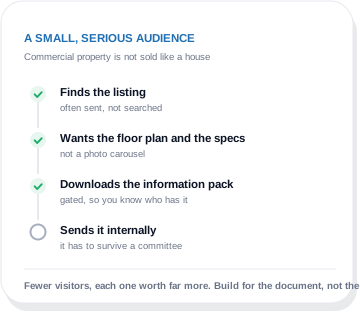
Why residential playbooks fail here
Most agencies offering commercial real estate website design are really building residential sites. Four things make commercial a different job.
Fewer visitors, each worth far more
A residential site optimises for volume. Yours does the opposite. A hundred qualified visitors a month who are genuinely in the market beats ten thousand browsers, and it changes every decision from the analytics you watch to the calls to action you use.
The document is the product
Floor plans, specifications, lease terms, schedules, zoning. The enquiry is usually made after the pack has been read, not before, so the site’s job is to get the pack into the right hands and tell you whose hands those were.
It gets forwarded, not searched
Links are sent by brokers, advisers and colleagues. The page has to make sense with no context and no salesperson attached, because it will be opened by somebody who was told nothing except “have a look at this”.
A committee decides, slowly
An acquisition or a lease goes through people who never contact you. The page has to survive being pasted into a board pack, which is a very different test from looking good on a phone.
What we build
Commercial real estate website design in practice is mostly these six, and the second one is where most sites simply have nothing.
Listing pages built for specifications
Floor area, floor plates, ceiling height, services, parking, lease type and term, availability. Presented as data rather than prose, because your reader is comparing against two other buildings on exactly those fields.
Gated information packs
The pack behind a short form, so the enquiry is captured at the moment of genuine interest and you know who is holding your numbers. Short, because a long form on a document request costs you the enquiry.
A portfolio that can be filtered
By use class, size, location and availability. For a landlord or an agency with any volume this is the difference between a website and a brochure, and it is what brokers actually use.
Availability that is not a lie
Nothing damages credibility faster than an enquiry about a unit that went six months ago. Whether that means a feed from your system or a simple process somebody owns, it needs deciding at the start.
Enquiries that reach a named person
Routed to the agent responsible for that asset, not to an info address. With a record of which pack was downloaded, because that context is most of the value of the enquiry.
Readable on the phone it was forwarded to
Specification tables are where responsive design usually collapses. If a broker cannot read your floor plate figures on a train, the pack does not get opened later.
What we can show you, and what we cannot
We would rather be straight about this than stretch something adjacent.
A residential real estate agent. Listings presented properly with real lead capture, replacing a brochure site that had none. Residential, not commercial.
A glass and aluminium company in Australia. Industrial rather than property, but the same problem: a cluttered site that failed to convey competence.
A written record of the structure, where listing data comes from and who receives each enquiry, plus a walkthrough recording.
No published commercial real estate case study yet
We have built for a residential agent and for industrial clients, and neither is a commercial property portfolio. We are not going to file them under commercial and hope you do not notice. What transfers is the specification-led presentation and the gated-document approach, both of which we have built elsewhere. If a published CRE result is what you need, say so on the call. The case studies are all there to check.
Where this is and is not worth doing
This page exists because the work is real, not because the search volume is. Being straight about that is more useful to you than pretending.
Worth doing if you hold or manage a portfolio
Multiple assets, recurring availability changes and brokers who need to find things. That is a system rather than a website, and it repays being built properly.
Probably not worth it for a single asset
If you are marketing one building once, a well-made single page and a good pack will do. We will tell you that rather than sell a portfolio platform you will use once.
Nobody finds you by searching, so do not buy traffic
Commercial property search volume is tiny and mostly the portals. The website earns its money on the credibility and speed of what happens after somebody is sent the link, which is where we would put the budget.
How a commercial real estate website design project runs
Four to eight weeks, and the first step decides the other three.
The asset list and the data
What you hold, what changes and who updates it. This answers whether we are building a system or a set of pages, and it is the decision everything else follows from.
The pack and the gate
Which documents go behind a form and which stay open. Agreed with whoever owns the enquiry, because it is a commercial decision rather than a design one.
Build and populate
Listing templates, filtering and the admin your team will actually use. We load real assets rather than placeholders so the layout is tested against your worst-case specification table.
Handover
Documentation and a walkthrough recording covering how to add an asset, change availability and pull the enquiry record. Your office runs it from day one.
Rated 4.9 out of 5 across more than 2,800 client reviews
We work with clients directly and on monthly retainers. We also work through Fiverr and Upwork, where we hold Top Rated and Top Rated Plus status. Here is what a few recent website and SEO clients said.


- Verified on Upwork
- Verified on Upwork
- Verified on Fiverr
- Verified on Upwork
- Direct client
- Verified on Upwork
- Verified on Fiverr
- Verified on Upwork
Questions from agencies and landlords
This sits under the industries we serve, alongside legal.
One asset or a portfolio?
That single answer decides almost everything about scope and budget, and it is the first thing we would ask on a call.
What does this cost?
A single-asset marketing site with a gated pack is usually 2,500 to 5,000 US dollars. A filterable portfolio site with availability management is more like 6,000 to 14,000, driven mostly by whether listing data comes from a system or is maintained by hand.
Can it connect to our property management system?
Sometimes. Some systems offer a feed or an API and some offer nothing usable. We check before quoting rather than after, and where there is no feed we will be honest that somebody in your office will be updating availability manually and design the admin so that takes minutes.
Should the information pack be gated?
Usually yes for the detailed pack and no for the headline specification. Hiding the floor area behind a form loses enquiries; hiding the full pack and the lease schedule captures them. The line sits between “enough to decide whether to look” and “enough to act”.
Do we need this if we are on the portals?
The portals will still bring you enquiries. What they will not do is present your portfolio as a whole, let a broker filter your stock, or tell you who downloaded what. For a single asset the portals may genuinely be enough, and we would say so.
How do you handle availability?
However you will actually maintain it. An elegant system nobody updates is worse than a plain one somebody does. We will ask who owns that job before designing it, because that answer determines the whole approach.
Is search worth anything in commercial property?
Honestly, very little in most markets. The searches are low volume and dominated by the portals. Where it does pay is specific: a particular submarket plus a use class, and the occasional “office space in [city]” term. We will tell you if there is something worth chasing rather than sell you a retainer.
Do you work outside the US?
Yes, across the US, UK, Canada, Australia and New Zealand. Terminology differs by market, use classes and lease conventions especially, and we will follow yours rather than impose an American one.
Tell us what you need and we will show you how we would do it
Share a few details about your business and what you want to fix or build. It could be a new website, a WordPress site that keeps breaking, SEO that has stalled, or a sales process that needs automating. We will come back with honest advice, even if that means a smaller job than you expected.
A reply within one business day
A real person on the team reads your message and replies, usually the same day.
A free review of your current setup
We look at your website, rankings or systems before we talk, so the call is useful.
A written proposal
You get a clear scope, timeline and price in writing before any work starts.
Prefer to talk first?