Ask three UK agencies what website maintenance costs and you will get three numbers that do not overlap. One quotes £25 a month, one quotes £150, one says it depends and asks for a call. None of them is necessarily lying. They are describing different amounts of work under the same two words.
This is a straight answer on what website maintenance costs in the UK in 2026, what you actually get at each price, and how to tell a real plan from an automated update bot with an invoice attached.
The short answer, in numbers
For most UK businesses, website maintenance costs between £30 and £250 a month. Brochure sites sit at the bottom of that range, ecommerce and booking sites near the top. Below about £30 a month you are usually paying for software rather than for a person. Above roughly £300 a month you are buying developer hours, not maintenance.
Put another way, website maintenance cost in the UK works out somewhere between £360 and £3,000 a year for a typical small or medium business site. One-off fixes sit outside it: expect £75 to £150 an hour from a UK developer, and £500 to £2,500 to clean up a hacked site properly.
What website maintenance actually covers
The phrase is vague because nobody has agreed on it. In practice a plan is some combination of eight things, and the price tracks how many are included and whether a human checks the result.
- Software updates. Core, plugins, themes, and the PHP version underneath them.
- Backups. Taken off the server, and restored occasionally to prove they work.
- Security. Firewall, malware scanning, login hardening, and someone who notices when it fires.
- Uptime monitoring. An alert when the site goes down, ideally before your customers tell you.
- Performance. Caching, image handling, and keeping Core Web Vitals from drifting.
- Small content edits. A new team member, a changed price, a seasonal banner.
- Fixing what breaks. Including when an update is what broke it.
- Reporting. Something that tells you what happened, in plain English.
The gap between a £25 plan and a £150 plan is almost never the first four. Automating updates, backups, scanning and monitoring is cheap. The difference is whether anybody reads the output, and whether a person fixes it when the automation makes a mess.
What UK agencies charge, band by band
These are the bands we see across the UK market, and what genuinely sits inside each one.
| Monthly cost | What it usually is | Best for |
|---|---|---|
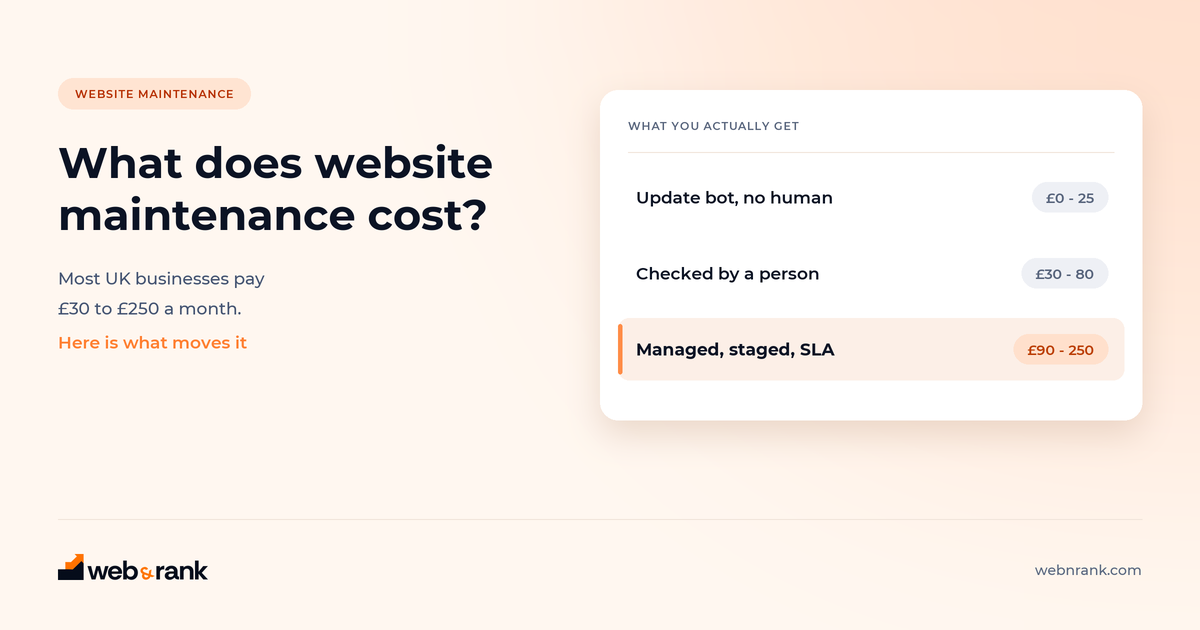
| £0 to £25 | Plugin licences and automated updates. No human review, usually a reseller dashboard. | Hobby sites, personal blogs |
| £30 to £80 | Automated updates with a monthly human check, off-site backups, uptime monitoring, a short report. | Brochure and marketing sites |
| £90 to £250 | All of the above plus staged updates, security response, small content edits, performance monitoring, a named contact and a response time in writing. | Lead-generating sites, small ecommerce |
| £300 to £600 | Managed maintenance with included developer time, priority response, a staging environment, proactive work rather than reactive. | Stores and booking systems that earn daily |
| £700 and up | Effectively a retained developer. Maintenance is a line item inside a bigger relationship. | High-traffic or custom-built platforms |
The band that catches people out is £30 to £80. It looks like a bargain next to £150, and for a simple brochure site it often is. It stops being a bargain the moment something breaks on a Friday, because that band rarely includes anybody being available to fix it.
What actually moves the price
Five things, roughly in order of how much they matter.
Whether you take payments. An ecommerce site carries a payment flow, customer data and a checkout that must not break. That is a different risk profile from a five-page brochure site, and it is the single biggest reason one quote is double another.
How many plugins you are running. Every plugin is a thing that can update badly. A site on twelve plugins is genuinely cheaper to look after than one on forty, and anybody quoting without asking has not looked.
How fast you need an answer. A plan with no stated response time is cheaper than one promising four business hours, because the second requires somebody to actually be there.
Whether updates are staged. Applying updates straight to the live site is free. Applying them to a copy first, checking the site still works, then pushing them live costs more, and is the reason your checkout does not break on a Tuesday morning.
Who built it. Agencies usually charge less to maintain their own builds, because they know where everything is. Inheriting somebody else’s site means an audit first, and some will not take it on without one.
What it costs by type of business
Bands are useful, but most people want to know where their own site sits. Four common cases.
A small business brochure site. Five to fifteen pages, a contact form, no payments. £30 to £80 a month covers it, and at the top of that range you should expect a human check rather than a bot. Over a year, £360 to £960.
A lead-generating service site. Landing pages, forms feeding a CRM, maybe a booking calendar. £90 to £250 a month. The jump is not about page count. It is that a broken form is lost revenue rather than a cosmetic problem, so it needs noticing quickly rather than eventually.
An ecommerce store. £150 to £400 a month for WordPress and WooCommerce, or £60 to £200 for Shopify on top of the platform fee. Checkout, payment gateway and stock sync all have to keep working, and all three depend on software you do not control.
Several sites at once. Multi-location businesses and franchises usually negotiate per site, and the per-site rate should fall. If you are paying full price across six sites that share one theme, you are paying for the same work six times.
WordPress maintenance costs specifically
WordPress runs a little over 40% of the web, so most UK maintenance quotes you receive are WordPress quotes whether or not the word appears in them. The bands above apply directly, but WordPress has two quirks worth pricing in.
The first is update volume. A site with twenty plugins will see updates most weeks, and occasionally two of them will disagree. That is ordinary, and absorbing it is most of what you are paying for.
The second is that WordPress is the most attacked platform on the web, purely because it is the most used. The overwhelming majority of those attacks target known vulnerabilities in outdated plugins, which is to say they target sites nobody is maintaining. That is the honest argument for a plan. Not that WordPress is fragile, but that an unmaintained WordPress site is a known quantity to the people scanning for them.
We have written separately about WordPress security and about speed optimisation, which is the other thing that quietly degrades while nobody is touching the site.
Shopify, Wix and Squarespace are not maintenance free
The pitch for hosted platforms is that maintenance is included. That is half true. The platform handles the server, the core software and the security patching, which is genuinely the boring half.
What is not included is everything specific to you. Apps still update and still conflict. Shopify stores accumulate apps the way WordPress sites accumulate plugins, and at £15 to £30 a month each they quietly become the larger bill. Content still needs changing, product data still drifts, and page speed still degrades as the theme gets edited.
Realistically a Shopify store costs £60 to £200 a month to look after properly on top of the platform fee, and a Wix or Squarespace brochure site £30 to £80. Lower than WordPress at the same tier, but not zero, and anybody telling you it is zero is selling the platform.
Hosting is not maintenance, and the invoice proves it
This is the most common misunderstanding we run into, and it costs people real money.
Hosting is the server your site sits on. Maintenance is the work done to the site on top of it. A managed WordPress host will keep the server patched, take backups and often auto-update core. What they will not do is notice that a plugin update broke your contact form, or that your booking calendar stopped sending confirmations, because they are not looking at your site. They are looking at their servers.
Good hosting reduces your maintenance bill. It does not replace it. If your current arrangement is £20 a month to a host and nothing else, you do not have maintenance. You have hosting and an assumption.
The three ways agencies bill for this
Monthly retainer. A fixed amount for a defined scope. Predictable, which is why most businesses end up here. The risk is paying for a plan you never use on a site that never changes.
Ad hoc, by the hour. £75 to £150 an hour in the UK, usually with a minimum charge. Cheapest if genuinely nothing goes wrong, and the most expensive way to handle an emergency, because you are at the back of the queue behind everyone on a retainer.
Blocks of hours. Buy ten, draw them down. A reasonable middle ground, though hours often expire, so read that clause before you buy.
One thing worth knowing about hourly: it pays somebody for time rather than outcome, and you cannot see the final number when you agree to it. Fine for a one-off fix, poor for ongoing care.
What skipping maintenance actually costs
The case for a plan is not that something will definitely break. It is that the repair costs a multiple of the prevention, and arrives at a moment you did not choose.
Cleaning up a hacked WordPress site properly, meaning finding the entry point rather than deleting the obvious files, runs £500 to £2,500 in the UK. If the site was quietly seeding spam links before anyone noticed, add the recovery work to get it showing in Google again, which takes months rather than days.
A checkout that breaks after a silent plugin update costs whatever you would have sold. Most businesses find out from a customer, which means it has usually been broken longer than they think. And a site left on an outdated PHP version eventually stops being supported by its host at all, which turns a routine upgrade into an emergency migration.
Set against £50 to £150 a month, the arithmetic is not close. That does not mean every site needs a plan. It means a site that generates enquiries or takes payments almost certainly does.
How to read a maintenance quote without getting stung
Five questions. They take two minutes, and they separate real plans from dashboards.
Are updates staged or applied live? If the answer is vague, they are applied live.
What is your response time, in writing? “We will get to it” is not a response time. One business day is. Four business hours is better, and costs more.
When did you last restore a backup? A backup nobody has restored is a hope, not a backup. Good providers test them.
What is specifically excluded? Every plan excludes something. The honest ones tell you before you sign.
Am I locked in? Twelve-month minimums on maintenance are a commercial choice, not a technical necessity.
One red flag deserves its own line. If a quote arrives without anybody having looked at your site, it is a price list, not a quote. Plugin count and platform change the work materially, so a real number requires a real look.
What we charge, and why we publish it
We run WordPress maintenance plans at $99, $199 and $399 a month per site, billed in USD, for businesses across the UK, US, Canada, Australia and New Zealand. Care covers brochure and marketing sites. Care Plus is for stores, booking sites and anything taking payments. Managed is for sites that earn their keep daily and need developer time on tap.
We publish the numbers because the alternative is a call where you tell us your budget first, and we would rather not work that way. Most of the market lands between £75 and £300 a month for a plan with a real team behind it. If a quote sits well below that, the question is not why it is cheap. It is which of the eight things above is missing.
Common questions
How much should I pay someone to maintain my website?
For a UK brochure site, £30 to £80 a month is reasonable. For a site generating enquiries, £90 to £250. For ecommerce or anything taking bookings, £150 to £400. If you are paying under £25 a month, check whether a human is involved at all, because at that price it is usually software and a dashboard.
How much does website maintenance cost per month in the UK?
Most UK businesses pay between £30 and £250 a month. The median for a small business site with a real provider behind it sits around £80 to £150. Ecommerce runs higher because the risk is higher, and one-off emergency work is billed separately at £75 to £150 an hour.
Do websites really need monthly maintenance?
A static brochure site that never changes can survive on quarterly updates. Anything running WordPress with plugins, taking payments, or generating enquiries needs monthly attention, because updates arrive monthly whether or not anybody applies them. The question is not whether the work happens. It is whether it happens on a schedule or during an outage.
How much does it cost to maintain a WordPress website?
The same bands apply: £30 to £80 for a simple site, £90 to £250 for a business site, £300 and up for a store. WordPress sits slightly higher than hosted platforms at the equivalent tier because update volume is higher, and lower in total cost of ownership because you are not paying per app.
Is website maintenance included in hosting?
No, although managed hosts blur the line. Hosting covers the server, its security patches and usually core updates. It does not cover your plugins conflicting, your contact form silently failing, or your content changing. Good hosting reduces the maintenance bill without replacing it.
How much should I charge for website maintenance as a freelancer?
In the UK, £40 to £90 a month per brochure site and £120 to £250 for ecommerce is a defensible range, assuming you are doing the work rather than reselling a dashboard. Price on the response time you are genuinely willing to honour, because that is the part clients actually feel.
What happens if I stop paying for website maintenance?
Nothing, for a while, which is what makes it easy to cancel. Updates stop being applied, backups usually stop with the plan, and the site drifts until something breaks or a known vulnerability finds it. The first few months look like a saving. The cost arrives all at once, at a time you did not pick.
Working out what your own site needs
If you are comparing quotes and the numbers do not make sense against each other, the problem is almost always scope rather than price. Ask the five questions above of each one and the gap usually explains itself in about ten minutes.
If you are earlier than that and still deciding how the site itself should be built, our comparison of a custom WordPress theme against a template covers the build-cost side of the same question.
If you would rather somebody just looked, we will tell you what your site needs and what it should cost, including when that is less than you are paying now.