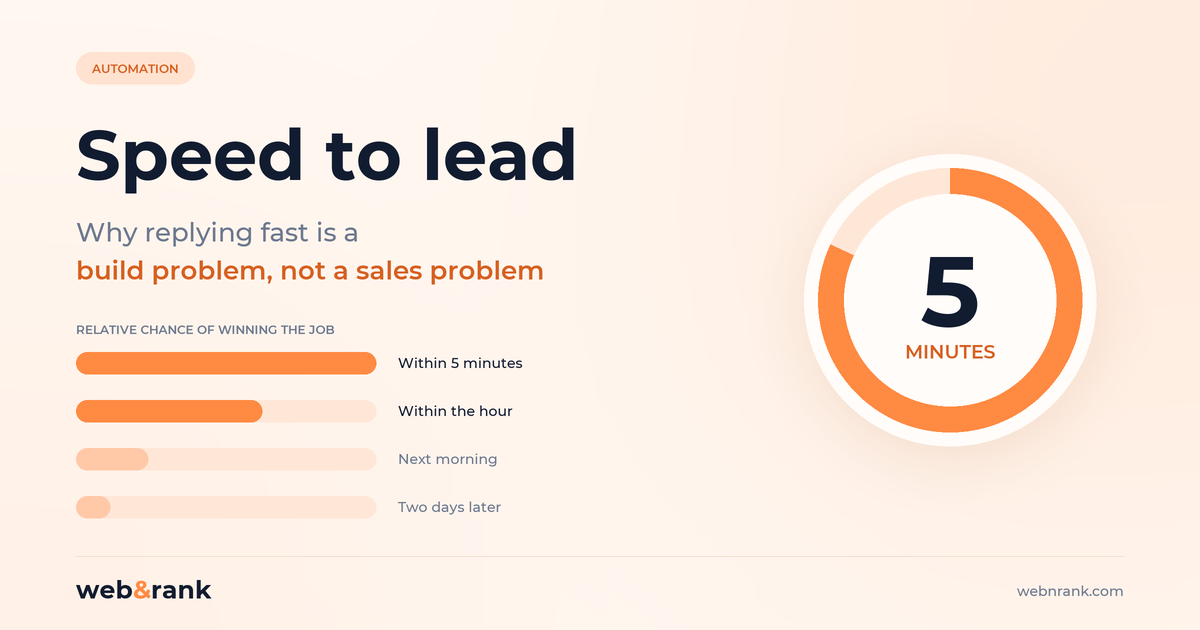
The short version. Speed to lead is the time between an enquiry arriving and a human replying. It is usually fixed by building something rather than by asking the team to try harder.
- Reply time is measured to the human reply, not to the automated receipt
- Telling people to be quicker works for about nine days, then a busy week happens
- Build these five, in this order: missed call text back, an instant human-sounding acknowledgement, routing to a named person, an escalation when nobody touches it, and an honest after-hours answer
- Every sequence needs a stop rule, and the stop rule needs testing
- None of it creates demand. If nobody is enquiring, this is the wrong project
A roofer we work with keeps his phone in a plastic bag because he is usually holding a wet tile when it rings. He misses roughly a third of his calls. Every one of those callers had already found two other roofers before they found him, and they are ringing all three in the same sitting.
He does not have a marketing problem. His ads work, his map pack position is good, the phone rings. He has a speed to lead problem, and it is costing him more than any campaign could win back.
What speed to lead actually means
Speed to lead is the elapsed time between a prospect submitting an enquiry and a person from your business responding to them. It is measured to the human reply, not to the automated confirmation.
Put less formally: it is the time between somebody raising their hand and a human being getting back to them. Not the time until your CRM logs it. Not the time until it appears in a shared inbox. The time until the person who sent the enquiry hears from somebody who can help.
That distinction matters because almost every business measures the wrong one. The form fires, the automation confirms receipt, the dashboard shows a lead captured, and everyone feels fine. Meanwhile the enquiry sits in a queue until Monday, and by Monday it has been answered by a competitor.
What the evidence actually says, and what it does not
The number everyone quotes comes from a 2011 Harvard Business Review article, The Short Life of Online Sales Leads, based on work by James Oldroyd. Across roughly 1.25 million leads, firms that attempted contact within an hour were about seven times more likely to have a meaningful conversation with a decision maker than those that waited an hour longer, and more than sixty times more likely than those that waited twenty four hours.
Two honest caveats, because this study gets waved around as if it settles everything. It is well over a decade old, and it looked at business-to-business web enquiries rather than a homeowner with a leak. The direction is almost certainly right and the exact multipliers almost certainly are not, particularly in consumer trades where the caller is ringing three numbers in five minutes.
So treat the shape as reliable and the decimals as decoration. Fast wins. Very fast wins considerably more. Slow loses to whoever was faster, regardless of who was better.
Why telling the team to reply faster does not work
Every business that has this problem has already had the meeting about it. Somebody said we need to be quicker, everyone agreed, and for about nine days it improved. Then a busy week happened.
That is not a discipline failure. It is a design failure. You are asking people to do something reliable in the gaps of a job that is already full, and reliability is not what humans are for. The roofer cannot answer the phone because his hands are inside a roof. The conveyancer cannot reply in five minutes because she is in a completion meeting. The clinic cannot pick up because the front desk is with a patient.
Which is the actual point of this article: reply time is a build problem. It gets fixed by building something that responds when the person cannot, not by asking the person to try harder.
The five things to build, in the order that pays
1. Missed call text back
A missed call triggers a text within seconds: who you are, that you saw the call, and a question about what they need. For any business where the customer expects to phone, this single automation is usually worth more than everything else on this list combined, because it converts the calls you were already losing rather than trying to win new ones.
It also changes the medium. Plenty of people would rather text than talk, and a text gives you a written record of what they wanted before you ring back.
2. An instant acknowledgement that reads like a person wrote it
Not “your submission has been received”. Something that names what they asked about, says when a human will reply, and gives them one thing to do meanwhile. The purpose is not to convert. It is to stop them continuing down their list of three, which is exactly what silence encourages.
3. Routing to a named person, never a shared inbox
An enquiry that arrives at info@ arrives at nobody. Route it to a person by name, based on whatever rule actually matches your business: the service, the location, who is on duty. When one person owns it, response time collapses without anyone trying.
4. An escalation when nobody has touched it
The rule can be crude. If the enquiry has not been opened within thirty minutes during working hours, it goes to somebody else and the owner gets told. Most businesses never build this, and it is the step that stops a good week from quietly hiding a lost enquiry.
5. An honest after-hours answer
Most enquiries do not arrive at eleven in the morning. They arrive at nine at night, from a phone, after the kids are down. You do not have to staff that. You do have to tell the person what happens next and when, because “we will call you at eight tomorrow” holds somebody far better than nothing does.
What this is worth, roughly
Take your enquiries per month, the proportion you currently answer the same day, and your average job value. Most businesses we audit are answering somewhere between half and two thirds of enquiries on the day they arrive, and the untouched remainder is where the money is. You do not need a model. Recovering a quarter of those, at your normal close rate, is usually a bigger number than the entire marketing spend that generated them.
We have seen this play out in both directions. An online store we rebuilt now recovers 47 percent of its abandoned carts because follow up runs on a timer instead of a good intention. A residential cleaning service went to 3.2 times the booking enquiries largely because online booking and an instant quote removed the phone tag entirely.
What speed to lead will not fix
It will not create demand. If nobody is filling in the form, responding to nobody faster changes nothing, and that is a search and advertising problem rather than a follow-up one.
It will not rescue a price nobody will pay. Answering in ninety seconds simply gets you told no sooner, which is worth something but not what you were hoping for.
It will not survive being pointed at the wrong people. Automating follow up to a list of unqualified enquiries just annoys more people per hour. Fix who is arriving before you speed up what happens to them.
And it absolutely must stop when somebody replies. A sequence that keeps chasing a customer who already answered is the fastest way to make a good system feel like spam. Every sequence needs a stop rule, and testing that stop rule is not optional.
Where to start this week
Find out how many calls you actually miss. Most phone systems will tell you and most owners guess low by a wide margin. That one number usually decides whether missed call text back or form routing is the first thing to build.
Then time yourself honestly. Send an enquiry through your own website form on a Friday evening and see what happens, and how long it takes. Nearly everyone who does this is unpleasantly surprised, which is the useful part.
Most of what is described here is ordinary plumbing rather than anything clever, and it is what our business automation services exist to build. For businesses running on inbound calls, it usually lives in GoHighLevel. For a sales team with a real pipeline, it belongs in Salesforce. The tool matters much less than whether anybody has actually built the thing.
If you want the sector-specific version of this argument, it is on our home services page, where whoever answers first genuinely does get the job, and on our legal page, where the same enquiry is worth a great deal more and the intake is usually the weakest part of the firm.
Common questions about speed to lead
What does speed to lead mean?
Speed to lead is the elapsed time between an enquiry arriving and a person from the business replying to it. It is measured to the human response rather than to the automated confirmation, which is why many businesses think their reply time is far better than it is.
How quickly should you respond to leads?
Inside five minutes where the enquiry is competitive or urgent, such as a trade callout or a legal matter, because the person is usually contacting two or three businesses in the same sitting. Within the hour is a reasonable target for considered purchases. The gap that costs most is not five minutes against fifteen, it is same day against next day.
Why is speed to lead important?
Because in most markets the enquiry is not exclusive to you. The customer has a shortlist and the first credible reply frames the rest of the conversation. Being better than the competitor rarely helps if they answered first and you answered on Monday.
How do you improve speed to lead without hiring anyone?
By building the response rather than staffing it. A missed call that sends an automatic text, an acknowledgement that names what was asked, routing to a named person instead of a shared inbox, and an escalation when nobody has opened it within thirty minutes. None of that needs a new employee.
What is missed call text back?
An automation that sends a text message within seconds of a call going unanswered, usually asking what the person needed. It matters because many callers will not leave a voicemail and will simply ring the next business on their list. For trades and home services it is often the single highest-return automation available.
Does speed to lead matter for B2B as well as consumer businesses?
Yes, though it works differently. In consumer and trade work the caller is comparing three businesses within minutes. In B2B the enquiry often goes to a committee over weeks, so a fast reply matters less for beating a competitor to the phone and more for getting into the evaluation before the shortlist closes.
What should you measure?
Median time to human reply, split by working hours and out of hours, plus the proportion of enquiries that get any reply on the day they arrive. Averages hide the problem because one enquiry answered four days late distorts them. The proportion answered same day is usually the number that moves the revenue.