Financial advisor website design where trust is the whole product
Nobody hands their pension to a website. What a website can do is get you onto the shortlist and off it: prove you are a real regulated firm, show who they would actually be dealing with, and remove enough uncertainty that booking a first call feels like a small step rather than a commitment. Financial advisor website design for advisers, brokers and accountants across the US, UK, Canada, Australia and New Zealand.
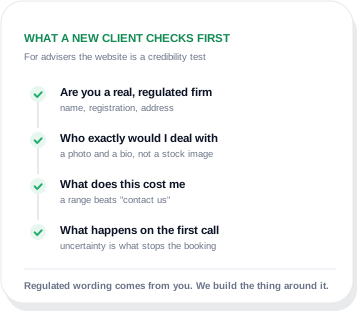
What a prospective client checks first
Four questions, usually answered in under a minute. If your site answers three of them the call gets booked; if it answers one it does not.
Are you a real, regulated firm
Registration details, a proper address, the regulator you answer to, and a real company name rather than a trading style floating on its own. This is checked within seconds and a site that hides it fails the test immediately.
Who exactly would I deal with
A name, a photograph that is genuinely of them, and what they specialise in. Stock photography of models at a boardroom table does measurable harm here, because the entire decision is about trusting a person.
What is this going to cost me
A fee structure, or at minimum a range and what moves it. “Contact us to discuss” reads as evasion in a sector where people already suspect they are being charged in ways they will not see.
What actually happens next
What the first call covers, how long it takes, whether it commits them to anything. Most people never book because they do not know what they are agreeing to, which is a copy problem rather than a design one.
What we do and what stays with you
This is the clearest line on any page we have written, and it is the one you should hold every agency to.
We write the copy that gets somebody to book
Structure, clarity, the order of the argument, the parts that remove hesitation. That is a communication problem and it is what we are for.
Regulated wording comes from you
Risk warnings, required disclosures, how a service may be described, whether a testimonial is permitted at all. That is set by your regulator and your compliance function, not by us, and we will not draft it for you or tell you what is allowed.
We flag, you decide
Where a sentence reads like a claim, a guarantee or advice, we mark it and hand it back. Getting that argument out of the way in week two is much cheaper than having it after a compliance review.
What we build
Six things, and the first two carry most of the result.
Adviser profiles that do the convincing
Real photography, qualifications, what they actually handle and who they typically work with. For most firms this is the highest-performing page on the site and it is usually the thinnest.
Booking, with the uncertainty removed
A calendar with a clear description of what the first conversation is and is not. Naming the length and the fact that it commits them to nothing lifts booking rates more than any redesign.
Fees explained like a human would
A structure, worked examples where you can give them, and plain wording. Firms that publish something here consistently beat firms that do not, even when they are more expensive.
Accessibility, properly
A large part of this audience is older. Contrast, text sizing and keyboard navigation are not a checkbox here, they decide whether somebody can use the site at all.
Sensible handling of anything sensitive
A website form is for arranging a conversation, not for collecting financial details. We keep the form minimal and route anything else into whatever secure system you already run.
Fast and readable on a phone
Often being read in the evening by somebody who has just had a reason to think about money. Slow, cramped pages lose them and the visit does not come back.
What we can show you, and what we cannot
The shortest section on this page, because we are not going to pad it.
A migration law firm. A different regulated profession, and the same problem: a slow high value decision where trust and a fast reply decide it.
A real estate agent. Not financial services, included because it is the same job of making an unfamiliar professional feel like a safe choice.
A written record of what was built and where every form submission goes, which in this sector is a question you should be asking.
No published financial services case study yet
We have not built for an adviser, broker or accountancy firm and published the result, and we are not going to dress up one of the above as finance. What we can point at is regulated, trust-led work where the buying decision has the same shape. If a published finance result is what you need, we are not the firm, and we would rather say it here than in week three. The case studies are all there to check.
Whether this is worth doing at all
Financial advisor website design is a small search market. We would rather tell you where the return actually is than sell you a retainer chasing it.
Do not expect search volume to save you
The terms here are low volume and the informational ones are owned by Investopedia, Schwab and the trade press. A website in this sector earns its money by converting referrals and introductions, not by ranking.
Most of your leads are already referrals
Which means the site is a credibility check performed after the recommendation, not a discovery channel. That should change where the budget goes: profiles, fees and booking, rather than content marketing.
So the honest brief is smaller
Most advisers need an excellent eight-page site, not a content programme. That is a cheaper project than you were probably quoted, and we will scope it that way.
Rated 4.9 out of 5 across more than 2,800 client reviews
We work with clients directly and on monthly retainers. We also work through Fiverr and Upwork, where we hold Top Rated and Top Rated Plus status. Here is what a few recent website and SEO clients said.


- Verified on Upwork
- Verified on Upwork
- Verified on Fiverr
- Verified on Upwork
- Direct client
- Verified on Upwork
- Verified on Fiverr
- Verified on Upwork
Questions from advisers and firms
This sits under the industries we serve, alongside legal.
Where do your clients come from now?
If the answer is referrals, the website has a narrower and cheaper job than you may have been told. That is usually good news for the budget.
What does an adviser website cost?
A well-built site for a small firm, with adviser profiles, fee explanation and booking, is usually 3,500 to 8,000 US dollars. Larger firms with multiple offices and service lines run higher. If you have been quoted twenty thousand for eight pages, ask what exactly the money is buying.
Will you handle our compliance?
No, and be wary of any agency that says yes. We build the site and write the persuasive copy, then flag anything that reads like a claim or advice for your compliance sign-off. What your regulator permits is a question for your compliance function, and an agency guessing on your behalf is a risk you are carrying, not us.
Can we publish client testimonials?
That depends entirely on your regulator and it changes by jurisdiction, so ask your compliance function rather than us. What we can tell you is that where testimonials are not permitted, the substitutes that work are specific case narratives without identifying details, clear process descriptions and genuine adviser credentials.
Should we publish our fees?
In our experience yes, or at least a structure and a range. It filters out people who were never going to proceed and it markedly increases booking rates among people who were. The usual objection is that competitors will see them, and they already can.
Do we need a blog?
Probably not, and this is where most advisers waste money. Unless somebody in the firm genuinely enjoys writing and will keep it up, a handful of excellent permanent pages beats a blog abandoned after four posts. An abandoned blog with a 2019 date on the last entry actively damages the credibility everything else is building.
We are an accountancy practice rather than an adviser. Does this apply?
Largely yes. The trust test, the fee question and the booking problem are the same, and the compliance boundary works identically even though the rules differ. The main change is that accountancy has more recurring service work, so the site should make the ongoing packages clear rather than focusing on a single first appointment.
Do you work outside the US?
Yes, across the US, UK, Canada, Australia and New Zealand. Regulators and terminology differ considerably between them, which is precisely why we write the copy and you own the regulated wording.
Tell us what you need and we will show you how we would do it
Share a few details about your business and what you want to fix or build. It could be a new website, a WordPress site that keeps breaking, SEO that has stalled, or a sales process that needs automating. We will come back with honest advice, even if that means a smaller job than you expected.
A reply within one business day
A real person on the team reads your message and replies, usually the same day.
A free review of your current setup
We look at your website, rankings or systems before we talk, so the call is useful.
A written proposal
You get a clear scope, timeline and price in writing before any work starts.
Prefer to talk first?