A SaaS SEO agency that writes for the committee, not the champion
Your champion is already half sold. The people who kill the deal are the ones they forward the link to: a security reviewer looking for a reason to say no, and a finance lead looking only for the price. Most SaaS sites are written entirely for the first reader and lose to the other two. We build search traffic and pages that survive being forwarded. Working with SaaS companies across the US, UK, Canada, Australia and New Zealand.
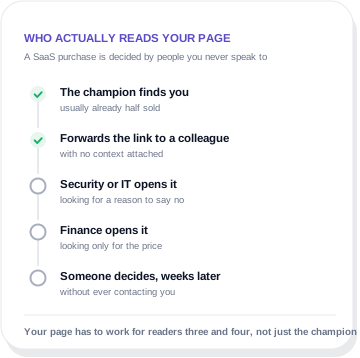
Who actually reads your page
A B2B SaaS purchase is rarely one person deciding. Write for one reader and three others find reasons to say no.
The champion
Found you through a search or a peer. Already believes. Needs ammunition rather than persuasion, which means a page they can forward without having to explain it.
Security or IT
Opens the link looking for a reason to stop this. Wants to know where data sits, what certifications you hold and whether you will survive a review. If that page does not exist, they invent an objection.
Finance
Scrolls straight past everything to find a number. If pricing is “contact us”, you have just converted a live deal into a chase, and in a two-quarter evaluation that is where things quietly die.
The committee, weeks later
Decides in a meeting you are not in, from a document somebody else wrote using your page. The page has to be quotable, because that is literally how it gets used.
Where SaaS search traffic actually comes from
Not from your homepage and rarely from your blog. A SaaS SEO agency earning its fee is usually working on three things.
Pages at scale, generated from your own data
Integration pages, use-case pages, template or directory pages: one page per real thing, built from a structured source rather than written one by one. Done properly this is the biggest lever in SaaS search. Done badly it is thousands of thin pages and a manual action.
Comparison and alternative pages
Somebody searching your competitor plus “alternative” is deep in an evaluation and worth more than any top-of-funnel post. These pages need to be genuinely fair to win, which most companies cannot bring themselves to do.
The technical layer, because SaaS sites break it
App subdomains, JavaScript rendering, faceted URLs, staging environments left indexable. A surprising share of SaaS SEO problems are crawling problems rather than content problems, and they are cheaper to fix.
The signup is part of the page
Traffic that arrives and does not start a trial is a cost, not a win. Three things decide it and none of them are the hero image.
Ask for less than you want
Every field between interest and product is a tax. Work email and nothing else beats a qualified form, because you can qualify after they are inside and looking at something.
Show the product, not a stock illustration
Real screens, real data shapes, ideally an interactive tour. Buyers in an evaluation are trying to picture their own workflow and cannot do it from an abstract graphic.
Publish a price, or a range
“Contact us for pricing” filters out the people who would have converted and keeps the ones who will haggle. If enterprise pricing genuinely varies, publish the shape of it and say what moves the number.
What it looks like when the page does its job
One published SaaS result, and what every engagement includes regardless.
A SaaS company whose static page converted under one percent. Rebuilt around clear copy, real product proof and a much shorter signup.
Worth stating, because a percentage increase means nothing without the baseline. We record it before touching anything.
A written record of what changed, the keyword map and a walkthrough recording, so your team can keep publishing without us.
One case study, not a portfolio
We have published one SaaS result rather than ten, and you should weigh that. The problem shape is one we know well, and the same discipline shows up in our web application work, but we would rather point at one real number than imply a practice. Ask on the call what the closest match to your situation is.
Four ways SaaS SEO goes wrong
We have been called in to fix all four, and the first one is expensive to undo. Picking a SaaS SEO agency is largely a question of which of these they will talk you out of.
Thin pages at scale
The fastest way to turn programmatic SEO into a penalty. If a page has nothing on it that a human would want, generating ten thousand of them makes the problem ten thousand times worse rather than bigger.
A blog with no job
Publishing weekly because somebody said to, on topics nobody evaluating software searches for. We would rather write eight pages that map to buying intent than fifty that map to nothing.
Comparison pages nobody believes
A comparison page where you win every row convinces no one and is often worse than having none. Concede the things your competitor genuinely does better and the rest becomes credible.
SEO and the app treated as one site
Marketing pages and the product are different problems with different technical needs. Trying to serve both from one framework is where the crawling issues usually start.
Rated 4.9 out of 5 across more than 2,800 client reviews
We work with clients directly and on monthly retainers. We also work through Fiverr and Upwork, where we hold Top Rated and Top Rated Plus status. Here is what a few recent website and SEO clients said.


- Verified on Upwork
- Verified on Upwork
- Verified on Fiverr
- Verified on Upwork
- Direct client
- Verified on Upwork
- Verified on Fiverr
- Verified on Upwork
Questions from SaaS teams
This sits under the industries we serve, alongside ecommerce.
Know your trial-to-paid rate?
That number and your signup rate together tell us whether the problem is traffic, the page or the product. It is usually not the one people expect.
What does a SaaS SEO agency cost?
Retained work is usually 2,000 to 6,000 US dollars a month depending on how much content and technical work is in scope. A one-off project such as a programmatic page build or a technical audit and fix is 4,000 to 12,000. We would rather start with a project and let you judge the work than open with a twelve month retainer.
How long until it shows?
Technical fixes can move things in weeks. Content and programmatic pages realistically take four to eight months to compound, and anybody promising SaaS rankings in sixty days is either lucky or lying. We set a baseline and report against it monthly so you can stop if it is not working.
Do you do the writing or do we?
Either, and the honest answer is that your team usually writes better product copy than we do. Where we add most is deciding what to write, in what order, and making sure each page owns one search intent. For technical content, a hybrid works best: we build the brief and structure, your team supplies the substance.
Can you build programmatic pages for us?
Yes, and the first question is whether you have a data source worth generating from. Integrations, locations, job roles, templates, public datasets. If the answer is “we could make something up”, the answer is no, because that is exactly the thin-page trap.
We already have an in-house marketer. Where do you fit?
Usually on the technical layer and the structure, leaving execution in house. That is often the best value arrangement: you already have somebody who knows the product, and what they lack is the search architecture and the time to fix crawling problems.
Is this different from your normal SEO work?
The discipline is the same and the tactics differ. SaaS leans much harder on programmatic pages, comparison content and technical crawling than a local business does. If you want the general picture, our SEO page covers it, and this page covers what is specific to software.
We are pre-revenue. Should we be doing SEO at all?
Probably not as your main channel. SEO compounds slowly and pre-revenue companies usually need to learn faster than that. Get the positioning and the signup right, do the technical groundwork so you are not paying to fix it later, and come back to content when you know what converts.
Tell us what you need and we will show you how we would do it
Share a few details about your business and what you want to fix or build. It could be a new website, a WordPress site that keeps breaking, SEO that has stalled, or a sales process that needs automating. We will come back with honest advice, even if that means a smaller job than you expected.
A reply within one business day
A real person on the team reads your message and replies, usually the same day.
A free review of your current setup
We look at your website, rankings or systems before we talk, so the call is useful.
A written proposal
You get a clear scope, timeline and price in writing before any work starts.
Prefer to talk first?