Medical website design for practices that want the phone to ring less
Patients do not want to ring you. They want to see whether you treat their problem, roughly what it costs, and the next free appointment, at nine in the evening on a phone. Most practice websites answer none of those three, so the front desk absorbs the difference. Medical website design for clinics, dental and medical practices across the US, UK, Canada, Australia and New Zealand.
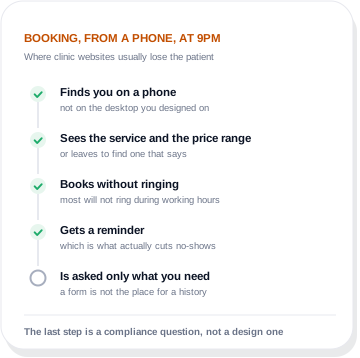
Where practice websites lose the patient
Not at the design. Almost always at one of five ordinary steps, and usually the same one.
- They arrive on a phone, on a site laid out for a desktop, and give up on the third pinch to zoom
- They cannot tell whether you treat their specific problem, because the services page lists departments rather than conditions
- There is no price range anywhere, so they go and find a practice that publishes one
- Booking means ringing during the hours they are at work, which is the single biggest loss
- They book, then forget, because nothing reminded them
None of that is fixed by a nicer homepage. It is fixed by shortening the distance between arriving and having an appointment.
The front desk absorbs the difference
Every one of those five failures turns into a phone call, and the practice pays for it in reception time rather than in a line on a report. That is why it goes unnoticed for years: the website looks fine and the cost is hidden in somebody’s afternoon.
- Calls that are only asking your opening hours
- Calls asking whether you treat a condition your site never named
- Calls asking a price the site could have given as a range
- Callbacks chasing patients who forgot an appointment
What we build for a practice
Medical website design in practice is mostly these six. The order depends on where your bookings are leaking now.
Booking that works at nine at night
Connected to the system you already use rather than a form that emails reception. If your practice management software has a booking API or a widget, that is what we wire in, because a second calendar nobody checks is worse than no calendar.
Reminders that cut no-shows
Text and email, timed, with a way to reschedule rather than just cancel. No-shows are the cheapest money a practice ever recovers and it is almost entirely a reminders problem.
Pages built per condition, not per department
Patients search for the thing that hurts, not for your org chart. A page per condition or treatment, written in the words patients actually use, is where practice search traffic comes from.
Accessibility taken seriously
Real contrast, real keyboard navigation, text that resizes. A large share of your patients have a reason to need it, and in healthcare it is closer to a duty than a nice-to-have.
Clinician profiles that do work
A photo, credentials, and what they actually treat. Patients choose a person more often than a practice, and a stock image of a smiling stranger in a white coat does the opposite of reassuring.
Speed on a real phone
Measured on a throttled connection, because the patient is in a car park, not at a desk. Every second of load time costs bookings and nobody notices because the site feels fine on the office wifi.
The part that is not a design decision
Some of this page is design opinion. This section is not, and it is where healthcare work differs most from every other sector we build in.
What a form may ask
A website contact form is not the place to collect symptoms, a history or anything that belongs in a record. We build forms that capture enough to book and nothing more, and route the rest into whatever secure system you already run. We are not your privacy advisor, and where a question needs one we will tell you to ask rather than guess on your behalf.
Claims and wording
What a practice may claim about outcomes is governed by your regulator and your indemnity, not by what converts. We will write copy that performs inside those limits and flag anything that reads like a promise. The final wording is signed off by you.
Where patient data actually sits
A booking widget that posts into your practice software is a different risk from a form that emails reception and sits in an inbox for a year. We will tell you plainly which one you are choosing and what it means.
What we can show you, and what we cannot
We would rather answer this before you ask it.
A residential cleaning service. Different sector, identical problem: online booking and an instant quote replaced a phone tag loop.
A migration law firm. Also not healthcare, also a slow high value enquiry handled properly at the intake.
A written record of what was built, where patient data flows and who owns each part, plus a walkthrough recording for your team.
No published healthcare case study yet
We have not published a clinic or dental build, and we are not going to relabel one of the above as healthcare. What we can offer is the same problem solved where the shape matches: slow, high value, trust-led enquiries and booking that has to work without a phone call. If a published healthcare result matters more to you than that, hire the firm that has one and we will say so on the call. The case studies are all here to check.
How a practice build runs
About six weeks, and the slow part is agreeing what may be said rather than building it.
Week one: what patients actually ask
We go through your enquiries and your front desk’s most repeated questions. That list becomes the site structure, because those questions are the pages.
Week two: the rules
What may be claimed, what a form may ask, who signs off. Written down before anything is designed, which is the step that stops a rebuild stalling in month three.
Weeks three to five: build and connect
Pages, booking, reminders and accessibility, built and tested against the real practice management system rather than a demo.
Week six: launch and watch
Switched on, monitored for a week, then handed over with documentation. We check the booking numbers with you a month later.
Rated 4.9 out of 5 across more than 2,800 client reviews
We work with clients directly and on monthly retainers. We also work through Fiverr and Upwork, where we hold Top Rated and Top Rated Plus status. Here is what a few recent website and SEO clients said.


- Verified on Upwork
- Verified on Upwork
- Verified on Fiverr
- Verified on Upwork
- Direct client
- Verified on Upwork
- Verified on Fiverr
- Verified on Upwork
Questions from practices
This sits under the industries we serve, alongside ecommerce.
Know your no-show rate?
If you do, that number alone usually tells us where the quickest return is. If you do not, it is the first thing worth measuring.
What does a practice website cost?
A single location practice with booking, condition pages and reminders is usually 4,000 to 9,000 US dollars. Multi-site or multi-clinician with per-location booking is more. The variable is rarely the design; it is how many treatments need their own page and whether your practice management system will talk to a website at all.
Can you connect it to our practice management software?
Usually, and it is the first thing we check rather than the last. Most of the common systems offer a booking widget or an API. Where a system genuinely will not open up, we will tell you in week one and we will not build a second calendar that nobody reconciles, because that creates a worse problem than it solves.
Are you HIPAA experts?
No, and be careful with any agency that says it is. We build forms and flows that collect as little as possible and route anything sensitive into systems you already run, and we will flag where a decision needs proper advice. The judgement on what your obligations are comes from your own advisor, not from your web team.
Will you write our clinical copy?
We will write the copy that gets somebody to book, and we will draft the rest for you to correct. Anything that reads as a claim about outcomes gets flagged for your sign-off. We would rather have that argument in week two than after a regulator reads it.
We are a dental practice. Is that different from medical?
Slightly, and mostly in the buying decision. Dental has more elective, price-sensitive treatment, so publishing ranges and finance options matters more and before-and-after imagery does real work, within whatever your regulator permits. The booking and reminder problem is identical.
Do you do the local SEO too?
Yes, and for a single location practice it is usually where the return is. Ranking in the map pack for your suburb plus a page per condition beats almost anything else you can buy. That side of it lives with our SEO work.
Can you rebuild without losing our existing rankings?
Yes, and it needs planning rather than luck. We keep the URLs that earn traffic, redirect anything that must move, and record what was ranking before so the comparison afterwards is a fact rather than an argument. We have rebuilt sites specifically to avoid this and it is a normal part of the job.
Tell us what you need and we will show you how we would do it
Share a few details about your business and what you want to fix or build. It could be a new website, a WordPress site that keeps breaking, SEO that has stalled, or a sales process that needs automating. We will come back with honest advice, even if that means a smaller job than you expected.
A reply within one business day
A real person on the team reads your message and replies, usually the same day.
A free review of your current setup
We look at your website, rankings or systems before we talk, so the call is useful.
A written proposal
You get a clear scope, timeline and price in writing before any work starts.
Prefer to talk first?